
Con
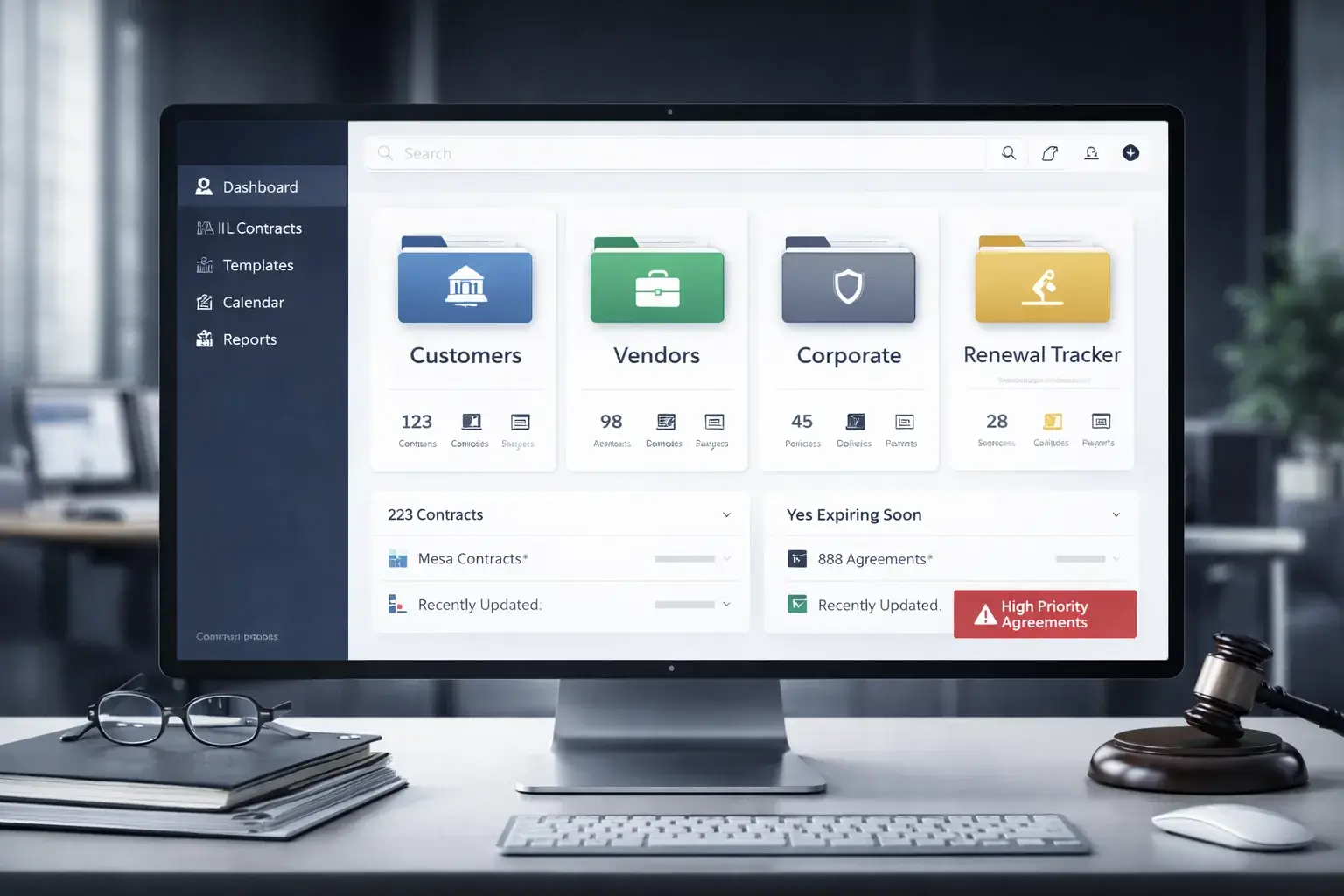
tract repository small business owners build is not about fancy software — it is about a naming convention, a folder structure, a proof packet standard, and a renewal tracker that an ops manager can actually run. Most 10–49 employee companies have the contracts. They just cannot find them when it matters. The retrieval failure, not the drafting failure, is what creates leverage problems in disputes and missed renewals.
This article is for informational purposes only and does not create an attorney-client relationship. Every business is different — consult counsel about your specific facts.
If you cannot find it, you cannot enforce it
When a dispute happens, the first question is: what did we sign, and where is it? If the answer takes more than five minutes, the system is not working. The inability to quickly produce a signed agreement, the relevant SOW, and the acceptance documentation is how leverage disappears before a lawyer is ever called.
The 5-minute retrieval standard (and how to achieve it)
A contract repository is not a random folder. It is a system with naming conventions, structure, and ownership.
- Pick a standard naming convention (Counterparty – Agreement Type – Effective Date – Version).
- Create top-level folders (Customers, Vendors, Real Estate, HR, Corporate).
- Require proof packets for each agreement.
- Create a renewal tracker and assign an owner.
- Lock the intake workflow: contracts only enter the system through the approved path.
Proof packets: what goes inside
A proof packet should make it easy to defend the deal without reconstructing history.
- Executed agreement PDF + e-sign audit log.
- All SOWs and change orders.
- Acceptance evidence.
- Invoices and any disputes/objections.
- Key emails that show approval and performance.
Renewal tracker: prevent accidental renewals and missed renegotiations
Most companies either miss renewals or get auto-renewed into bad terms. A renewal tracker fixes that.
What ‘done’ looks like
Done means the repository is used by the team, not just created.
- Repository and naming convention implemented.
- Intake workflow adopted (no side-channel contracts).
- Renewal tracker live with owner assigned.
- Proof packet standard trained and enforced.
- Authority matrix aligned to the repository workflow.
Why Contract Repository Small Business Setups Fail (And How to Fix Them)
Most contract repository small business implementations fail within six months of creation. Not because the folder structure was wrong or the software was bad — but because the intake workflow broke down and nobody owned the maintenance. Files started going back into email inboxes and desktop folders. The repository became a partial record rather than the authoritative record. When a dispute arose, the team still could not find everything it needed. The fix is not a better folder — it is an enforced intake process and a named owner.
The naming convention nobody follows
A contract repository is only as useful as its searchability. If contracts are saved as “final agreement v3,” “MSA signed,” or the vendor’s file name from the email attachment, retrieval fails. A working naming convention looks like this: CounterpartyName – AgreementType – EffectiveDate – Version. Every contract that enters the system uses this format. When a dispute arises and you search for the file, you find it in seconds. The discipline of enforcing the naming convention is the hard part — not the convention itself. Assign an owner. Make the convention a written standard. Enforce it on intake.
The intake workflow that breaks down
Most companies have a contract problem that is really an intake problem. Contracts are signed and never filed. Amendments are saved somewhere other than the original agreement folder. SOWs are attached to emails but never uploaded to the repository. When the dispute happens, the “repository” has half the documents and the team spends hours reconstructing the full file from inboxes. The fix is a simple intake rule: no contract is complete until it is filed in the repository. The e-sign platform can automate the first step — signed PDFs auto-route to a folder. A human intake step confirms the proof packet is assembled before the engagement is marked complete.
Proof packets that are never assembled
A proof packet is the document set that makes a contract dispute or a debt collection straightforward rather than a reconstruction project. It contains the executed agreement, all SOWs and change orders, the acceptance evidence, the invoices and payment history, and any material correspondence about performance or disputes. Most small businesses have all of these documents — in different locations. The proof packet is the discipline of assembling them in one place, per engagement, before you need them. Build the folder at signing. Add documents as the engagement progresses. When a dispute arises, you produce the packet in minutes.
The renewal tracker that does not exist
Auto-renewal is one of the most costly contract failures for small businesses. A multi-year vendor agreement renews automatically at unfavorable rates because the renewal date was never tracked. A software contract renews for a seat count the company no longer needs. A customer contract rolls over on terms that were negotiated years ago and never revisited. A renewal tracker is a simple spreadsheet or task list: counterparty name, agreement type, effective date, renewal date, notice period, and owner. The owner reviews the list 90 days before each renewal and decides whether to renegotiate, terminate, or auto-renew intentionally. It takes minutes per quarter to maintain.
The authority matrix that was never connected
A contract repository works best when it is connected to your signature authority policy. If contracts are signed by whoever is available and filed after the fact — or not filed at all — the repository will always be incomplete. The authority matrix defines who can sign what and at what dollar threshold. The intake workflow requires that signed contracts are filed before the engagement starts. When these two systems are aligned, the repository becomes the authoritative record for all commitments above the threshold. Companies that implement both see the intake discipline hold because the authority policy creates a natural checkpoint.
Full Protection Suite (Optional Modules)
If you want more than the spearhead install, these modules stack cleanly without scope creep:
- Revenue & Payment Protection Install (contract-to-cash system).
- Vendor & Change Order Control Install (protect margin and acceptance).
- Signature Authority & Contract Repository Install (find any signed agreement fast).
- Regulated Evidence Retention Add-On (only if your industry requires it; discussed after intake).
For additional reference:
Contract Repository Small Business: Summary
Use this checklist before each customer engagement to confirm your contract system is set up for success. The items above cover the core controls most small businesses need — without overengineering the process.
Frequently Asked Questions
Do we need new software for a repository?
Usually no. Many companies can do this with existing cloud storage plus an e-sign platform. The key is discipline and workflow.
Who should own the renewal tracker?
Someone operationally accountable for vendor/customer relationships. Legal can design it; ops must run it.
How do we prevent people from saving contracts in random places?
Make the approved path the easiest path and enforce a rule that unsigned or unfiled contracts do not exist.
Does this include contract negotiation?
Not by default. The install is about system setup and standardization; negotiation can be added with a defined scope.
Is litigation included?
No. Litigation is excluded by default.
Next Steps
If your company invoices customers and you want fewer payment disputes, faster collections, and cleaner documentation, start with a Systems Routing Audit. It is prepaid, fixed scope, and produces a clear bucket recommendation with a pre-filled SOW and a same-day stop-loss checklist.
Litigation is excluded by default; if litigation is ever needed, it is handled only under a separate, premium engagement.
Disclaimer: This content is not legal advice. Past results do not guarantee future outcomes. Contract enforceability depends on facts, industry, and execution.
Related resources on this site: