Data center zoning is where most projects are actually won or lost. Power, fiber and land price get a site on the shortlist, but a county board still has to approve the use, usually through a special use or conditional use permit after a public hearing. In Illinois and Wisconsin, the statutes that govern that hearing are short, specific and unforgiving: who must be named in the notice, what evidence counts, and how fast a challenge has to be filed. This guide walks through the six rules that decide the outcome, for developers and for the landowners and local officials sitting across the table.
We covered the political side of this fight in our post on data center moratorium bills. This piece covers the ordinary approval path, the one every project still has to walk even where no moratorium exists.
Why Data Center Zoning Is a Different Fight
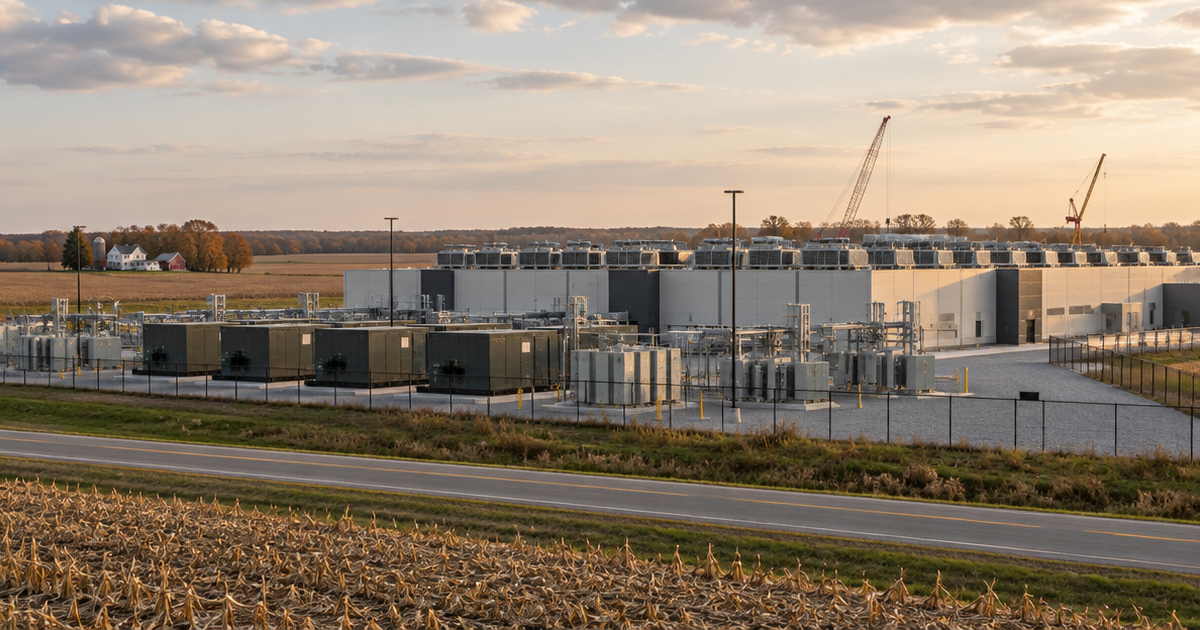
A warehouse and a data center can look identical from the road. The difference is everything behind the fence: rooftop cooling equipment that runs around the clock, yards of diesel backup generators, a substation, and an electric load far beyond a typical industrial user. Many older zoning codes never contemplated that combination, so a data center often does not fit as a use permitted “by right.” It lands in the discretionary column, which means data center zoning almost always involves a hearing, a record and conditions.
For a business owner, that discretion is the data center zoning risk. A project with signed land options and a utility commitment can still stall for a year because the hearing record was thin, the notice was defective, or neighbors framed the noise question better than the applicant did. For a landowner, it means the payout in an option agreement often depends on an approval nobody controls.
Rule 1: Know Whether Your Data Center Zoning Path Is a Rezoning or a Special Use
Illinois counties may classify special uses for, among other things, “uses that have a unique, special, or unusual impact upon the use or enjoyment of neighboring property,” under 55 ILCS 5/5-12009.5. That is the box most data center zoning requests end up in. Wisconsin uses the term “conditional use,” defined in Wis. Stat. § 59.69(5e) to include a special exception or other special zoning permission, but not a variance.
The distinction matters. A rezoning changes the map and is a broad legislative call. A special or conditional use asks whether this project, on this parcel, meets standards already written into the ordinance. If the land is zoned agricultural and the ordinance lists no data center use anywhere, you may need both a text amendment and a permit. Read the data center zoning provisions of the ordinance before you sign the option, not after.
Rule 2: The Hearing Notice Will Name Who Is Behind the Project
Developers often acquire land through project-named LLCs. In Illinois county proceedings, that anonymity ends at the special use notice. Section 5-12009.5(b) requires at least 15 days’ published notice, and the notice must state whether the applicant is acting as “an agent, alter ego, or representative of a principal and the name and address of the principal,” plus, for a corporate applicant, the officers, directors and any shareholder owning more than 20% of the stock.
The board of appeals must also give 15 days’ notice to any municipality within 1-1/2 miles of the property and to adjoining owners, including those across a street or right-of-way. The applicant pays for publication. Practical takeaway: a confidentiality clause in a land deal cannot promise secrecy past the hearing date, and a defective notice hands opponents a ground for a later challenge.
Rule 3: In Data Center Zoning, the Record Wins, Not the Crowd
Wisconsin is explicit. Under § 59.69(5e)(b), if an applicant “meets or agrees to meet all of the requirements and conditions” in the ordinance, “the county shall grant the conditional use permit.” Every condition must relate to the purpose of the ordinance and be based on “substantial evidence,” which the statute defines as facts and information “other than merely personal preferences or speculation.” The applicant carries the burden of showing the standards are met, and the county’s decision either way must rest on substantial evidence.
Illinois reaches a similar place by a different road. A special use “may be granted only upon evidence that the special use meets the standards established for that classification,” and conditions must be “reasonably necessary to meet those standards,” per Section 5-12009.5(c). The board of appeals reports findings of fact to the county board.
For developers, data center zoning success means expert reports on traffic, noise, water and property values should be in the record, not in a binder in the car. For opponents and local officials, it means testimony has to be specific. “We don’t want it here” is a preference. “The generator yard sits 300 feet from my bedroom window” is evidence.
Rule 4: Noise Is a Number, Not an Opinion
Cooling equipment is the most common objection at a data center zoning hearing, and in Illinois it is measured against state law, not just the county code. The Illinois Pollution Control Board’s property-line limits in 35 Ill. Adm. Code 901.102 cap sound reaching residential (Class A) land by octave band, with tighter limits at night. In the 1,000 Hz band, for example, sound from industrial (Class C) land to a home is limited to 52 dB during the day and 41 dB at night.
Because a data center runs 24 hours a day, the nighttime column is usually the one that binds. A site plan that works at noon can fail at 2 a.m. Applicants should commission an acoustic study measured against these tables before the hearing, and neighbors and counties can ask for compliance with them as a permit condition.
Rule 5: Backup Generators Carry Federal Hour Limits
The generator yard is the second-biggest flashpoint, and federal rules already shape how it may run. Under EPA’s engine standards at 40 CFR 60.4211(f), an emergency compression-ignition engine has no time limit in a true emergency, but maintenance and readiness testing is capped at 100 hours per calendar year. Up to 50 of those hours may be used in non-emergency situations, and, with a narrow exception, those 50 hours cannot be used for peak shaving or to sell power to the grid. An engine run outside those limits loses emergency status and must meet the stricter non-emergency standards.
That has two consequences. Developers should not promise a county a testing schedule they cannot keep, and they should not plan a business model that leans on the backup fleet for grid revenue without a separate permitting analysis. Counties, for their part, can write testing-window conditions (weekday daytime only, for example) into the permit, which stack on top of the federal cap.
Rule 6: The Data Center Zoning Appeal Clock Is Short
In Illinois, a county board’s decision on a special use, variance or rezoning is reviewed in court de novo “as a legislative decision,” and any challenge must be filed “not later than 90 days after the date of the decision,” under 55 ILCS 5/5-12012.1. Municipalities follow a matching rule in 65 ILCS 5/11-13-25. In Wisconsin, a denied applicant may appeal to circuit court under the procedures in § 59.694(10), and a county may route conditional use decisions straight to circuit court instead of the board of adjustment.
Ninety days goes fast when a project team is waiting on a utility study. Whether you are the applicant or the neighbor, calendar the deadline the day the vote is taken. When a hearing goes sideways, the record you built in Rules 2 through 5 is what a court will read. Our litigation team at Howard Law Group handles those challenges.
What Howard East Clients Should Do Now
- Developers: map the data center zoning path (by-right, special use, text amendment) for every shortlisted parcel before you sign options, and budget for acoustic, traffic and water studies as hearing exhibits.
- Landowners: read the approval contingency in your option agreement. If the payout depends on a permit, negotiate extension fees and a hard outside date. Our commercial real estate attorneys review these regularly.
- Counties and towns: update ordinances to define the use, set measurable conditions, and adopt generator testing windows before the first application arrives.
- Businesses near a proposed site: watch the notice list. If you are an adjoining owner in a data center zoning case, you are entitled to notice of the hearing, and the public hearing is your chance to put evidence in the record.
Rising power costs are the other half of this story; see our breakdown of what data center demand means for your energy bills. If a land option, host agreement or utility contract is on the transaction side, our transactional practice can help structure it.
Data center zoning rules vary county by county, and the state statutes above set only the floor. If you are planning a project, negotiating a land deal, or preparing to testify at a data center zoning hearing, book a consultation with Howard East to talk through your site and your timeline.
This article is for informational purposes only and does not constitute legal advice. Zoning procedures differ by county and municipality; consult an attorney licensed in your state about your specific situation.