A Stanford student was sent a university dining banner built from a photo he remembered a campus photographer taking, and noticed he was no longer in it. According to The Stanford Review, Stanford’s Residential & Dining Enterprises used AI to replace him with a generated figure of a different race and gender, and to make two other students look visibly thinner. Dr. Alex Wissner-Gross flagged the story in the September 22 issue of The Innermost Loop. For any business that runs AI marketing photos, the takeaway is simple: the retouching button now carries legal obligations that the old one did not.
What Happened, and Why AI Marketing Photos Matter to Your Business
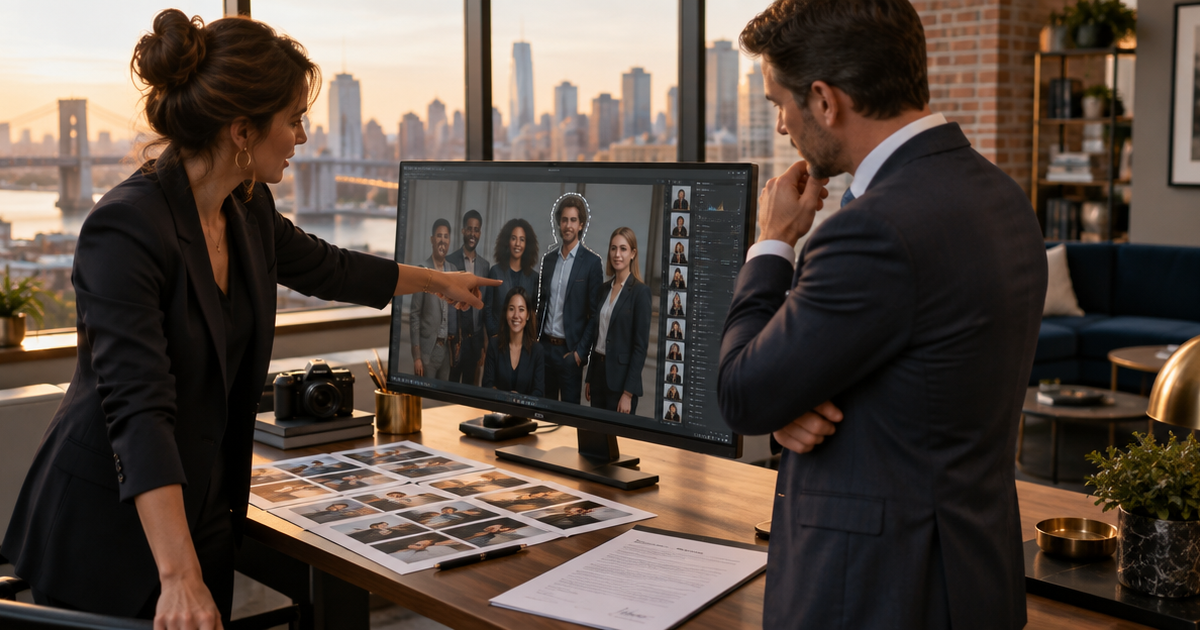
The account comes from a student newspaper, and we have not independently verified the before-and-after images. But the underlying workflow is common: a staff photographer shoots real people, the marketing team drops the file into an AI editor, and the edited version goes out as advertising. Nobody in that chain asks a lawyer, because for twenty years “retouching” meant fixing lighting and blemishes.
Generative tools changed what an edit can do, and AI marketing photos are where that change shows up first. In a few clicks you can now remove a person, insert someone who does not exist, change a face, or reshape a body. Each of those edits touches a different body of law. Removing a real person, adding a synthetic one, and altering someone who stays in the frame are three separate legal questions, and a single banner can raise all three at once.
This is not a Silicon Valley problem. Restaurants, clinics, dispensaries, gyms, schools, and professional firms all run photos of real customers and employees. If your team uses AI marketing photos in ads, social posts, or your website, the rules below apply to you now.
The Legal Impact: 5 Rules for AI Marketing Photos
1. Illinois requires written consent before your AI marketing photos use someone’s likeness
Under Section 30(a) of the Illinois Right of Publicity Act, a person “may not use an individual’s identity for commercial purposes during the individual’s lifetime without having obtained previous written consent.” “Identity” expressly includes a photograph, image, or likeness, and “commercial purpose” covers advertising or promoting goods or services and fundraising. The remedy is the greater of actual damages and profits or $1,000, plus punitive damages for willful violations, and the court may award the prevailing party attorney’s fees.
The practical question for AI marketing photos is scope. A release that let you photograph someone for “promotional use” may or may not reach an altered version of that person. That turns on the release language, and most releases were written before anyone contemplated changing a subject’s face or body.
2. New York is stricter: written consent, with criminal exposure
New York’s Civil Rights Law Section 50 makes it a misdemeanor to use “the name, portrait, picture, likeness, or voice of any living person” for advertising or trade “without having first obtained the written consent of such person,” or a parent or guardian for a minor. Section 51 adds a civil claim. If you market in New York, a verbal “sure, use my photo” is not enough, and neither is a release that never contemplated alteration.
3. New York now requires disclosure when an ad uses a synthetic person
This is the newest rule, and the one most businesses have missed. New York’s synthetic performer law (S.8420-A, now General Business Law Section 396-b) took effect on June 9, 2026. It requires anyone who produces or creates an advertisement to conspicuously disclose, where they have actual knowledge, that the ad includes a “synthetic performer.” The law defines that as a digitally created asset intended to look like a human performance by someone “not recognizable as any identifiable natural performer.” Penalties are $1,000 for a first violation and $5,000 for each one after that.
Apply that to AI marketing photos like the Stanford banner. The AI-generated figure who replaced a real student is exactly the kind of invented person the statute describes. Run that ad in New York without a disclosure and you have a violation. There are exceptions, including audio-only ads, AI language translation of a real performer, and promotion of expressive works such as films and games, but an ordinary marketing banner fits none of them.
4. Video and audio ads trigger Illinois’s digital replica rules
Illinois amended its Right of Publicity Act effective January 1, 2025 (P.A. 103-836) to address “digital replicas.” The statute defines a digital replica as an AI or computer-generated representation of an actual person’s voice, image, or likeness “fixed in a sound recording or audiovisual work in which that individual did not actually perform or appear.” Knowingly distributing a work that contains an unauthorized digital replica is now a separate violation.
Be precise about the reach. That definition is tied to sound recordings and audiovisual works, so a still banner is most naturally analyzed under the written-consent rule in Rule 1 rather than the replica provisions. Once AI marketing photos become a video spot or a social reel with edited people in them, both sets of provisions come into play. We covered the licensing side of these rules in our guide to AI voice and likeness deals.
5. Invented “customers” can violate the FTC’s testimonial rule
If AI marketing photos present the people in them as customers, the federal rule on consumer reviews and testimonials (16 CFR Part 465, effective 2024) comes into play. A “consumer testimonial” includes depictions of a person’s “likeness” that consumers are likely to believe reflect a real customer’s experience, and Section 465.2 prohibits a testimonial that materially misrepresents “that the reviewer or testimonialist exists.” Swapping a real diner for a generated one in a “see what our guests say” ad is the kind of edit that rule was written for. Businesses that already work with creators should read this alongside our note on influencer agreements and the FTC.
What We Don’t Know Yet
Some of this is unsettled, and we would rather say so. Whether a release signed before these tools existed covers an AI-altered likeness is a contract question that will turn on its exact wording, and New York’s synthetic performer law is barely three months old. The Stanford incident happened in California, which has its own right-of-publicity statute. Our analysis focuses on Illinois and New York, where Howard East clients operate. Europe adds its own labeling regime, covered in our post on EU AI Act transparency rules. The reputational risk is already settled: an audience that can spot the edit will treat AI marketing photos as a statement about your brand.
What Howard East Clients Should Do Now
- Inventory your live images. Identify every ad, landing page, and social asset showing a real customer, patient, student, or employee, and flag any AI marketing photos altered beyond basic color and lighting.
- Pull the releases. Confirm a written release exists for every identifiable person, and read whether it permits alteration, compositing, or AI modification. If it does not, get a new one or retire the image.
- Update your release form. Going forward, say plainly whether you may alter the image, including with AI, and whether the person may appear in video. Keep signed copies with the asset.
- Add a disclosure step for synthetic people. If an ad that runs in New York includes an AI-generated person, add a conspicuous disclosure before it ships. It costs nothing and removes that penalty exposure.
- Never present an invented person as a customer. Testimonial-style creative should use real customers who consented, with their real experience.
- Write it into your vendor contracts. If an agency or freelancer produces your creative, require them to disclose AI edits and stand behind the releases. If a campaign has already drawn a complaint, a demand letter can turn into a business litigation matter quickly, so involve counsel early.
Regulated industries face a second layer. Cannabis operators, for example, already work under advertising restrictions on who and what an ad may depict, and should coordinate AI creative with counsel who handles their licensing before anything runs.
Talk to Howard East Before Your AI Marketing Photos Ship
AI marketing photos are fast, cheap, and useful, and nothing here says to stop using them. The work is to make sure the consent, disclosure, and contract steps keep up with the tools. Howard East advises businesses on advertising compliance, intellectual property, and the contracts that sit behind creative work. Book a consultation with Howard East to review your release forms, your agency agreements, or a specific campaign before it goes live.
This article is for informational purposes only and does not constitute legal advice. Right-of-publicity and advertising rules vary by state and change often; confirm current law before relying on it.