Electronic signature policy SMB owners need is not a lengthy document — it is a defined workflow with three components: authority routing, audit trail preservation, and repository filing. Electronic signatures are fast and broadly enforceable in Illinois, Missouri, and New York. The dispute risk is not the technology. It is the process failure: the wrong person signed, the audit log was never saved, or the executed PDF is sitting in an email inbox rather than the contract repository.
This article is for informational purposes only and does not create an attorney-client relationship. Every business is different — consult counsel about your specific facts.
The risk is not ‘e-sign’ – the risk is sloppy e-sign
A defensible e-sign setup has three pillars: authority, audit trail, and repository. Every dispute about an electronic signature ultimately comes down to one of these three. Did an authorized person sign? Is there a complete record of when and how? Is the executed document stored in a retrievable, centralized location with the rest of the engagement file?
Illinois, Missouri, and New York: what is common (and what you should do)
All three states recognize electronic signatures in their legal frameworks, but enforceability is fact-driven.
The safest posture is to build a workflow that would look reasonable to a judge, an auditor, and your future self.
- Route signatures only to authorized signers (authority matrix).
- Require a single source of truth for templates (version control).
- Store executed PDFs with audit logs (proof packets).
- Use consistent naming conventions and folders (repository).
The 7-step e-sign workflow for SMBs (repeatable)
This workflow is intentionally boring. Boring is enforceable.
- Start from an approved template library (no random drafts).
- Generate the SOW/change order from the template (unique ID).
- Route internally for approvals per the authority matrix.
- Send for customer/vendor signature via e-sign platform.
- Capture the completed audit log and certificate.
- Save executed PDF + audit log + proof packet in the repository.
- Update renewal tracker and invoice references (if customer-facing).
Common failure modes (and how to prevent them)
Most e-sign disputes come from the same small set of mistakes.
What ‘done’ looks like
Done means e-sign becomes reliable infrastructure.
- Authority matrix adopted and embedded in routing.
- Approved template library created and locked.
- Repository + proof packet standard implemented.
- Training completed for the people sending agreements.
- An effective date set for go-forward use.
Why Electronic Signature Policy SMB Implementations Break Down
Most 10–49 employee companies implement electronic signatures without implementing an electronic signature policy. They set up a DocuSign or Adobe Sign account, start sending documents, and assume the platform handles the compliance. The platform preserves the audit trail for individual transactions — but it does not define who is authorized to sign, which template to use, where the executed document gets filed, or whether the proof packet gets assembled. Those are process decisions. Without them, the company accumulates signed documents scattered across platforms, inboxes, and personal folders, and the enforceability question becomes a reconstruction project.
The authority routing problem
The most common e-sign enforcement issue for small businesses is authority. Someone signed the agreement — but was that person authorized to bind the company? Illinois, Missouri, and New York courts evaluate apparent authority and actual authority differently, and the analysis is fact-specific. The practical fix is an authority matrix: a written document that defines who can sign what agreement type and at what dollar threshold. The e-sign workflow enforces it by routing signature requests only to authorized signers. No workarounds. If the deal is above the threshold, it routes to the right approver before it goes to the customer or vendor.
The version control failure
When a company uses multiple contract templates — or lets individual employees modify templates — signature disputes become version disputes. Which version did the customer sign? Was that the approved template? Did someone add a clause that was never reviewed? A template library with version control — a locked, approved set of standard agreements managed by a designated owner — eliminates this problem. All agreements start from the approved template. Modifications above a defined threshold require legal review before the document is sent for signature. The workflow is simple; the discipline is the hard part.
The audit trail that was never saved
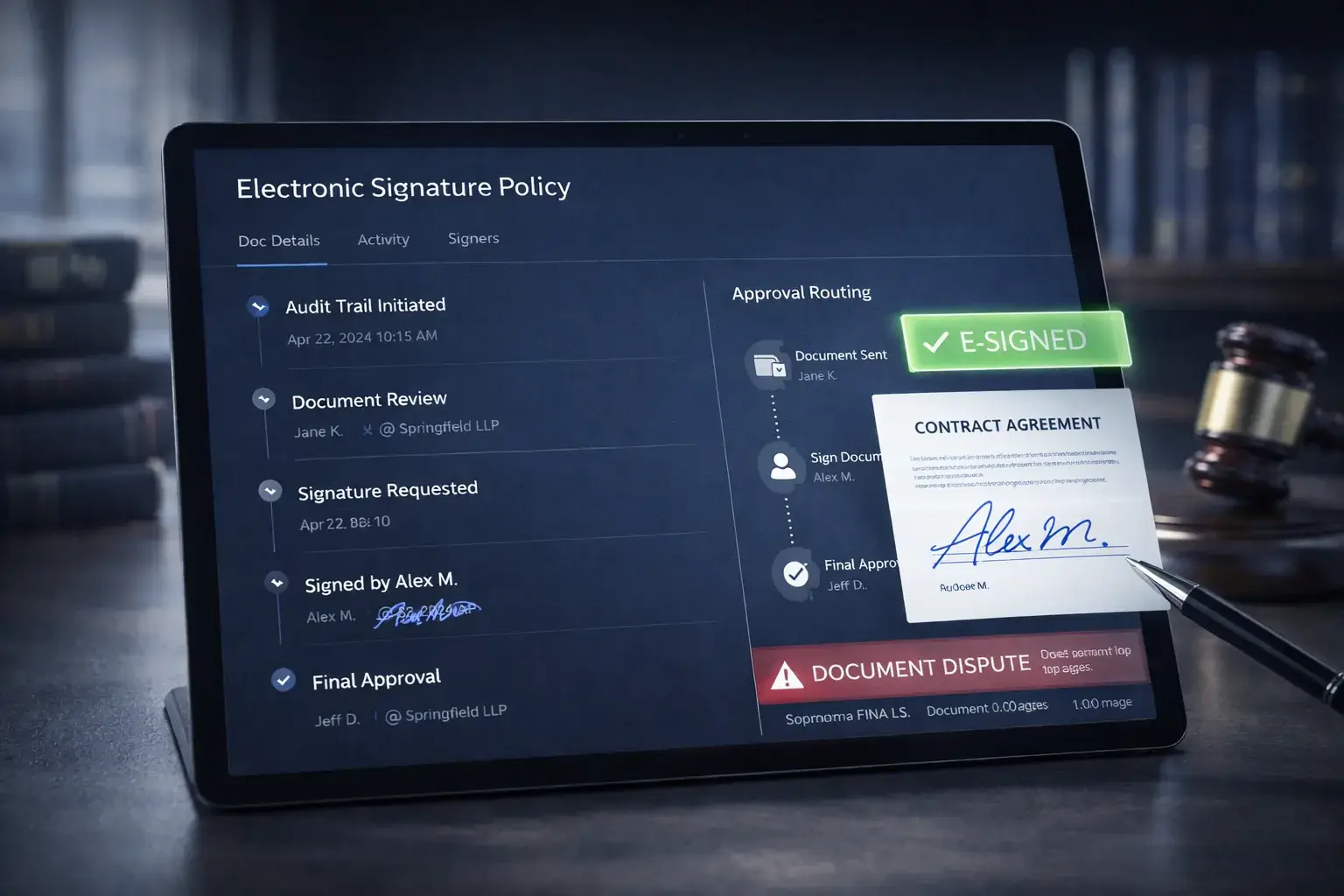
Every major e-sign platform generates a certificate of completion — a timestamped record of when each signer received, viewed, and executed the document, along with their IP address and authentication method. This certificate is the audit trail. In a dispute, it is the evidence that a specific person signed a specific version of the agreement at a specific time. Most small businesses never save it. The executed PDF gets filed (sometimes), and the certificate sits in the platform until it is needed — at which point the account may be expired, the user may have left the company, or the platform may have purged old records. The fix is a standard proof packet that includes the audit trail certificate alongside the executed PDF for every agreement above the threshold.
The repository that does not exist for e-signed documents
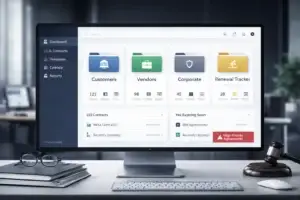
Electronic signature platforms create an illusion of organization. Documents are “in DocuSign” or “in Adobe Sign” — and that feels like a repository. It is not. It is a platform-specific archive with its own search, its own access controls, and its own retention risks. If the company changes platforms, cancels the subscription, or the account admin leaves, access becomes complicated. A contract repository is a centralized, company-controlled folder structure — typically in cloud storage your team already uses — where executed PDFs and audit trail certificates are filed alongside the rest of the engagement proof packet. The e-sign platform is the signing mechanism. The repository is the record of what was signed.
Training the team once and enforcing it
An electronic signature policy is only as effective as the team’s compliance with it. The most common failure mode after implementation is that the authority matrix is bypassed for “small” or “fast” deals. The template library is ignored when someone wants to customize an agreement. The proof packet step is skipped when the project is moving quickly. The fix is a one-time training — 30 to 60 minutes for the people who send agreements — combined with an effective date after which the new process is mandatory, and a named owner who enforces it. The investment is small. The enforcement risk of skipping it is not.
Full Protection Suite (Optional Modules)
If you want more than the spearhead install, these modules stack cleanly without scope creep:
- Revenue & Payment Protection Install (contract-to-cash system).
- Vendor & Change Order Control Install (protect margin and acceptance).
- Signature Authority & Contract Repository Install (find any signed agreement fast).
- Regulated Evidence Retention Add-On (only if your industry requires it; discussed after intake).
For additional reference:
- ESIGN Act — 15 U.S.C. § 7001 (Cornell LII)
- Uniform Electronic Transactions Act (UETA) — Uniform Law Commission
Electronic Signature Policy SMB Checklist
Use this checklist before each customer engagement to confirm your contract system is set up for success. The items above cover the core controls most small businesses need — without overengineering the process.
Frequently Asked Questions
Do electronic signatures always hold up in court?
They are generally enforceable, but disputes turn on authority, audit trails, and the facts of formation.
Can we implement this without a dedicated legal ops team?
Yes. The install is designed for 10-49 employee companies with lean teams.
Which e-sign platform should we use?
Use what you already have if it preserves audit trails. The workflow matters more than the brand.
Will this fix late payments?
It improves enforceability and reduces disputes. Combine it with acceptance triggers and a collections ladder for best results.
Is litigation included?
No. Litigation is excluded by default.
Next Steps
If your company invoices customers and you want fewer payment disputes, faster collections, and cleaner documentation, start with a Systems Routing Audit. It is prepaid, fixed scope, and produces a clear bucket recommendation with a pre-filled SOW and a same-day stop-loss checklist.
Litigation is excluded by default; if litigation is ever needed, it is handled only under a separate, premium engagement.
Disclaimer: This content is not legal advice. Past results do not guarantee future outcomes. Contract enforceability depends on facts, industry, and execution.
Related resources on this site: