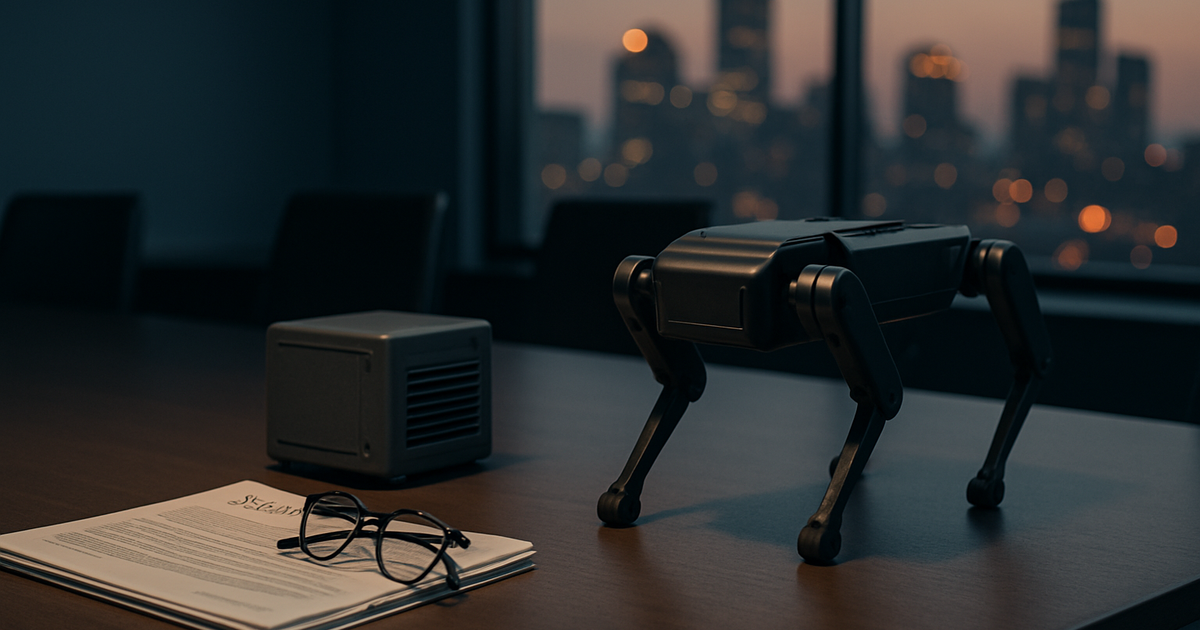
The FCC robot ban landed on July 28, 2026, and it is going to show up in commercial contracts long before it shows up in anyone’s warehouse. The Federal Communications Commission added two new categories to its Covered List: advanced robotic devices — defined as mobile robots such as humanoids and quadrupeds — and connected power inverters, when produced in a foreign country. Dr. Alex Wissner-Gross flagged the fallout in The Innermost Loop for July 30, noting that China’s commerce ministry has already threatened retaliation. The trade fight will get the headlines. The contract exposure is what will actually cost businesses money.
What the FCC Robot Ban Actually Does
Most electronic devices need FCC equipment authorization before they can be imported, marketed, or sold in the United States. Equipment on the FCC’s Covered List cannot receive that authorization. Adding a device category to the list does not seize inventory or outlaw ownership — it closes the front door to new models.
Four details matter more than the headline, and all four come straight from the FCC’s own fact sheet:
- It applies to new device models. Models the FCC already authorized may still be imported, marketed, sold, and used.
- It does not touch devices already purchased. Existing fleets keep operating.
- It is not limited to China. The interagency determination reaches foreign-produced devices “regardless of the nationality of origin.” Reporting has focused on Chinese manufacturers because they dominate the category, but the rule as written is broader.
- There is an exemption path. The Department of War may grant “Conditional Approval” for robotic devices, and the Department of Homeland Security for inverters, after finding a device or class of devices does not present unacceptable risk.
The FCC did not make this call on its own. Under the Secure and Trusted Communications Networks Act, the Commission can only update the Covered List at the direction of national security authorities — here, a White House-convened interagency body that found the devices create supply chain vulnerabilities and cybersecurity risk to critical infrastructure. Notably, CISA encourages organizations to use the Covered List in their own risk-management and compliance analysis, which means this list has gravitational pull well beyond the FCC’s jurisdiction.
What It Means for Business Owners
If you are not buying humanoid robots, you may assume this is somebody else’s problem. Be careful. Two things make the scope wider than it looks.
First, “mobile robots” is a broad phrase, and it is not yet obvious where the line falls. Reuters reported the ban as aimed at humanoids and quadrupeds, while The Verge has reported concerns that the definition could reach consumer devices such as robot vacuums and robotic lawnmowers. The FCC’s published materials define the category as mobile robots “such as humanoids and quadrupeds” without drawing a hard boundary. Until the Commission or the FAQ clarifies the edge cases, anyone whose product roadmap depends on imported mobile robotics is operating with real classification risk.
Second, and much less discussed: the same order covers connected power inverters. Inverters are the box that turns DC into AC in every solar array, battery storage system, and backup power installation in the country. If you are a solar EPC, a developer, a facilities operator, or a business that signed an installation contract with a delivery date and a fixed price, your equipment schedule just became a legal question.
The Legal Impact of the FCC Robot Ban
Here is where the FCC robot ban stops being a policy story and becomes a contract problem.
Supply agreements and change-in-law clauses
Somebody has to eat the loss when a specified model can no longer receive authorization. That answer lives in your vendor contract — specifically in the change-in-law, force majeure, and substitution provisions. Most mid-market supply agreements were drafted assuming regulatory risk was remote. Ask three questions of every affected agreement: Does force majeure cover a change in law, or only acts of God and labor disruption? May the seller substitute an equivalent authorized model without your consent, and at whose price? Who bears the cost of delay — and is there a liquidated damages clause that now triggers through no fault of either party?
If you specified a model by part number in a purchase order or a construction spec, you have a tighter problem than someone who specified performance requirements. Where the parties cannot agree on who absorbs the hit, these disputes go to commercial litigation quickly, because the dollars are concentrated in a single delivery schedule.
Warranties, firmware, and long-tail service obligations
A device authorized before July 28 remains legal to sell and use. But if you resell hardware and promised multi-year support, replacement units, or firmware currency, confirm your upstream supplier can still deliver. A ban on new model authorizations quietly shortens the practical life of a product line. Review your product and service warranties against what your supplier can actually now perform.
M&A due diligence and reps and warranties
If you are buying or selling a company whose revenue depends on imported robotics, automation, solar, or storage equipment, the diligence list changed this week. Which SKUs hold current FCC authorizations? Are any pending? Is there a Conditional Approval application on file? Regulatory compliance reps and product-line reps need to be read against the Covered List, and the answer may move price. This is the ordinary mechanism by which due diligence reprices the deal — and where indemnities and escrows earn their keep.
Regulatory compliance and operational exposure
Importing or marketing an unauthorized device is an FCC violation, not merely a customs headache. If you operate a capital-intensive facility — a warehouse, a manufacturing line, a build-out running on automated equipment, or a licensed regulated cultivation facility where automation and on-site power are part of the capital plan — your procurement team needs to check authorization status before the next order, not after. And if robots are already working alongside your people, the separate question of workplace robot liability has not gone anywhere.
One honest caveat: this rule is four days old. Enforcement posture, the precise boundary of “advanced robotic device,” and how quickly Conditional Approvals move are all unresolved. Any lawyer telling you exactly how this plays out is guessing. What is not speculative is that the authorization status of your equipment is now a contract term worth reading.
What Howard East Clients Should Do Now
Four concrete steps, in order:
- Inventory the exposure. List every mobile robot, power inverter, and automation component on order or in your build-out plan. Note whether each model was FCC-authorized before July 28, 2026.
- Pull the contracts. For anything unauthorized or pending, read the change-in-law, force majeure, substitution, and delay-damages clauses. That is where your money is.
- Write to your suppliers now. Ask in writing whether each specified model holds a current authorization and whether they have filed for Conditional Approval. A written record dated close to the rule change is worth a great deal if this becomes a dispute.
- Fix it in the next agreement. New supply and construction contracts should allocate Covered List risk expressly, permit equivalent-model substitution, and tie acceptance to authorization status.
Call a lawyer when a specified model is unauthorized and the contract is silent on who pays, when a supplier invokes force majeure, when a deal in diligence has meaningful robotics or inverter revenue, or when a delivery date you have already promised a customer is now at risk.
Talk to Howard East
Howard East advises business owners on supply agreements, regulatory exposure, and transactions across Illinois, Missouri, Wisconsin, and New York. If the FCC robot ban touches your equipment schedule, your vendor contracts, or a deal you are working, schedule a consultation and we will read the clauses that decide who pays.
Hat tip to The Innermost Loop by Dr. Alex Wissner-Gross, where this development surfaced.
This article is for informational purposes only and does not constitute legal advice.