The MSA SOW Illinois service businesses pair together solves one of the most common contract problems in small business: scope is agreed verbally, the deliverables land in a one-page email, and when a dispute arrives there is nothing to point to. A Master Service Agreement sets the baseline rules; a Statement of Work pins down scope, price, and timeline for each engagement. Without both documents working together, every project is one miscommunication away from a collection problem.
This article is for informational purposes only and does not create an attorney-client relationship. Every business is different — consult counsel about your specific facts.
Most SMB contracts fail because the stack is incomplete
The MSA SOW Illinois service businesses pair together solves one of the most common contract problems in small business: scope is agreed verbally, the deliverables land in a one-page email, and when a dispute arrives there is nothing to point to. A Master Service Agreement sets the baseline rules; a Statement of Work pins down scope, price, and timeline for each engagement. Without both documents working together, every project is one miscommunication away from a collection problem.
Most collection problems are not caused by ‘bad customers.’ They are caused by missing acceptance rules, inconsistent payment terms, and a lack of a documented escalation ladder.
The goal is not to write longer contracts. The goal is to install a simple system your team can actually follow.
An MSA without a clean SOW is vague. A SOW without acceptance is unenforceable in practice. A stack without change orders invites margin bleed.
The contract stack approach solves this with consistent documents and a consistent workflow.
What goes in the Illinois contract stack (and what does not)
The stack is designed for speed. It is not a 40-page monument.
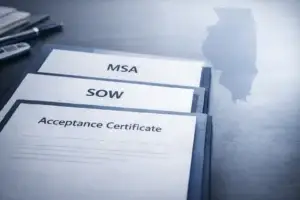
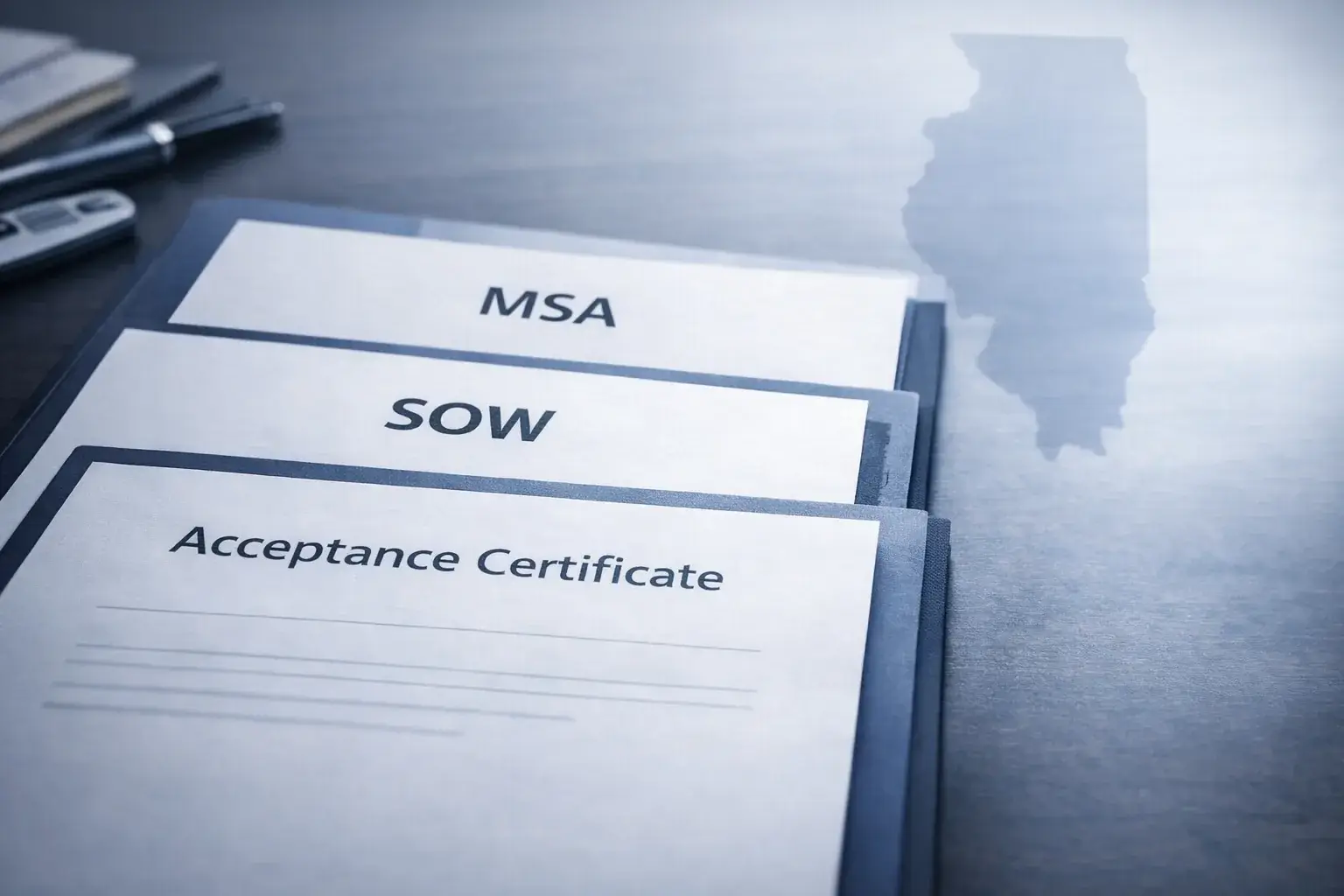
- MSA: baseline terms (payment, disputes, liability, confidentiality).
- SOW: scope, deliverables, pricing, timeline, assumptions.
- Acceptance certificate: objective sign-off trigger.
- Change order: the only way to add scope or cost.
- Invoice terms addendum: consistent late-charge/interest language (Illinois-calibrated).
Acceptance certificates: simple, objective, powerful
Your acceptance certificate should be short and tied to the deliverables in the SOW.
It is not a trap. It is a clean closing mechanism.
Illinois payment terms: consistency beats creativity
Use consistent, Illinois-calibrated language across your stack. Avoid one-off invoice terms that contradict the MSA.
The install standardizes late-charge/interest posture and a right to suspend work for nonpayment.
Implementation: how to roll this out without chaos
The rollout is as important as the drafting.
- Select one customer segment to pilot (your most common deal type).
- Train sales/ops on when to use MSA vs SOW vs change order.
- Set the rule: no work starts without signed SOW and correct signer.
- Install repository and proof packet storage.
- Use the change order rule immediately on the next scope change.
What ‘done’ looks like
Done means your team stops improvising contracts.
- MSA/SOW/Acceptance/Change Order templates delivered in Word.
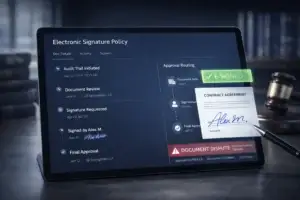
- E-sign versions configured.
- Authority matrix adopted.
- Repository structure and proof packets live.
- Training completed with named owners.
Why MSA SOW Illinois Service Companies Get Wrong (and What to Fix)
Most Illinois service businesses understand in theory that they need a Master Service Agreement and a Statement of Work. In practice, the MSA SOW Illinois companies actually use tends to share three structural problems that make the stack unenforceable when a dispute arrives.
The MSA is a template nobody updated
The most common version of this problem: the company downloaded an MSA from the internet five years ago, changed the company name, and has been using it ever since. The payment terms reference a state they do not operate in. The liability cap is expressed as a multiple of fees paid “in the prior twelve months” — which, in a new engagement, means nearly nothing. The dispute resolution clause names a venue that does not exist. None of these issues surface until a customer pushes back on an invoice and your own document works against you. A functional MSA for an Illinois service business should reference Illinois law by name, use Illinois-calibrated interest and late-charge language, and be reviewed by counsel at least once.
The SOW is a proposal with a signature box
Proposals are sales documents. Statements of Work are contract documents. The difference is specificity. A proposal says “we will design and build your marketing site.” A SOW says: five pages, defined in the attached wireframes, delivered by March 14, accepted via written sign-off from an authorized representative of the client, with specific exclusions listed. Without that specificity, the SOW does not function as a scope control. Every out-of-scope request becomes a negotiation about what “the project” ever meant. Fixing a SOW template takes an hour. Not fixing it costs far more than that in the first scope dispute.
The acceptance certificate is missing entirely
Most Illinois service firms invoice at completion with no written acceptance step. The customer delays payment. Their reason: the work is not done yet, or was done incorrectly, or does not meet an expectation that was never written down. An acceptance certificate closes this gap. It does not need to be a multi-page document. A one-paragraph form confirming: (1) the deliverable described in the SOW, (2) the date it was completed, and (3) the name of the authorized contact who accepted it — is enough. Paired with your change order workflow, acceptance certificates convert the end of every project from a negotiation into a documented event.
The stack is inconsistent across documents
Even when all three documents exist, most Illinois companies have conflicting terms scattered across them. The MSA says Net 30. The invoice template says Net 15. The SOW is silent on payment timing. When the customer gets to court — or even to their own legal department — that inconsistency is their first argument. Standardizing the contract stack means making sure every document references the same defined terms. It is a one-time project, not ongoing legal work. After it is done, your documents stop creating the disputes you are trying to prevent.
Training closes the gap between policy and practice
Even a well-drafted MSA SOW stack fails if the people who actually send contracts do not know when to use which document, what the SOW must include before work starts, or who has authority to sign on behalf of the company. Most Illinois service businesses need a 45–60 minute rollout session covering the stack, the change order rule, and the acceptance process. That session converts the documents from a legal artifact into a functional system. Without it, the templates sit in a shared folder and the team keeps improvising. The rollout is not optional — it is the last mile that makes the install real.
Full Protection Suite (Optional Modules)
If you want more than the spearhead install, these modules stack cleanly without scope creep:
- Revenue & Payment Protection Install (contract-to-cash system).
- Vendor & Change Order Control Install (protect margin and acceptance).
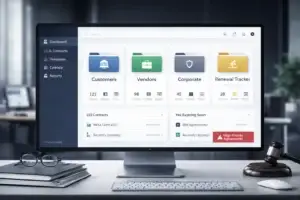
- Signature Authority & Contract Repository Install (find any signed agreement fast).
- Regulated Evidence Retention Add-On (only if your industry requires it; discussed after intake).
For additional reference:
- Illinois Uniform Commercial Code (810 ILCS 5)
- Master Service Agreement — Legal Definition (Cornell LII)
MSA SOW Illinois Implementation Checklist
Use this checklist before each customer engagement to confirm your contract system is set up for success. The items above cover the core controls most small businesses need — without overengineering the process.
Frequently Asked Questions
Do we need an MSA for every customer?
Not always. But most repeating customer relationships benefit from a consistent MSA plus deal-specific SOWs.
Is an acceptance certificate too formal for small deals?
It can be simplified. The key is an objective acceptance trigger that supports invoicing.
Can we keep using our existing invoice template?
Yes, but it must align with the contract stack. Contradictions create disputes.
Will this reduce disputes?
It reduces preventable disputes by removing ambiguity. It does not eliminate bad actors.
Is court work included?
No. Litigation is excluded by default.
Next Steps
If your company invoices customers and you want fewer payment disputes, faster collections, and cleaner documentation, start with a Systems Routing Audit. It is prepaid, fixed scope, and produces a clear bucket recommendation with a pre-filled SOW and a same-day stop-loss checklist.
Litigation is excluded by default; if litigation is ever needed, it is handled only under a separate, premium engagement.
Disclaimer: This content is not legal advice. Past results do not guarantee future outcomes. Contract enforceability depends on facts, industry, and execution.
Related resources on this site: