Payment Terms Illinois SMBs Must Enforce to Get Paid in 2026
The payment terms Illinois service businesses rely on are only as strong as the system supporting them. Most companies write “Net 30” into a contract and assume the work is done. It is not — and the gap between a due date and an actual payment is where most collection problems live.
This article is for informational purposes only and does not create an attorney-client relationship. Every business is different — consult counsel about your specific facts.
The real reason invoices go unpaid (and it is not your accounting software)
Most Illinois service businesses lose leverage before a dispute ever starts. The problem is not a bad customer — it is a paper stack that does not function as a collection tool: scope language too vague, acceptance triggers undefined, invoice terms copied from a vendor in a different state. The result is ambiguity, and ambiguity is always more expensive than the fix.
Most collection problems are not caused by ‘bad customers.’ They are caused by missing acceptance rules, inconsistent payment terms, and a lack of a documented escalation ladder.
The goal is not to write longer contracts. The goal is to install a simple system your team can actually follow.p>
In practice, your payment terms succeed or fail at three moments: (1) when scope changes, (2) when delivery is accepted, and (3) when the invoice is issued with leverage.
Your goal: remove ambiguity so your customers cannot weaponize confusion.
A state-safe way to think about late charges and interest in Illinois
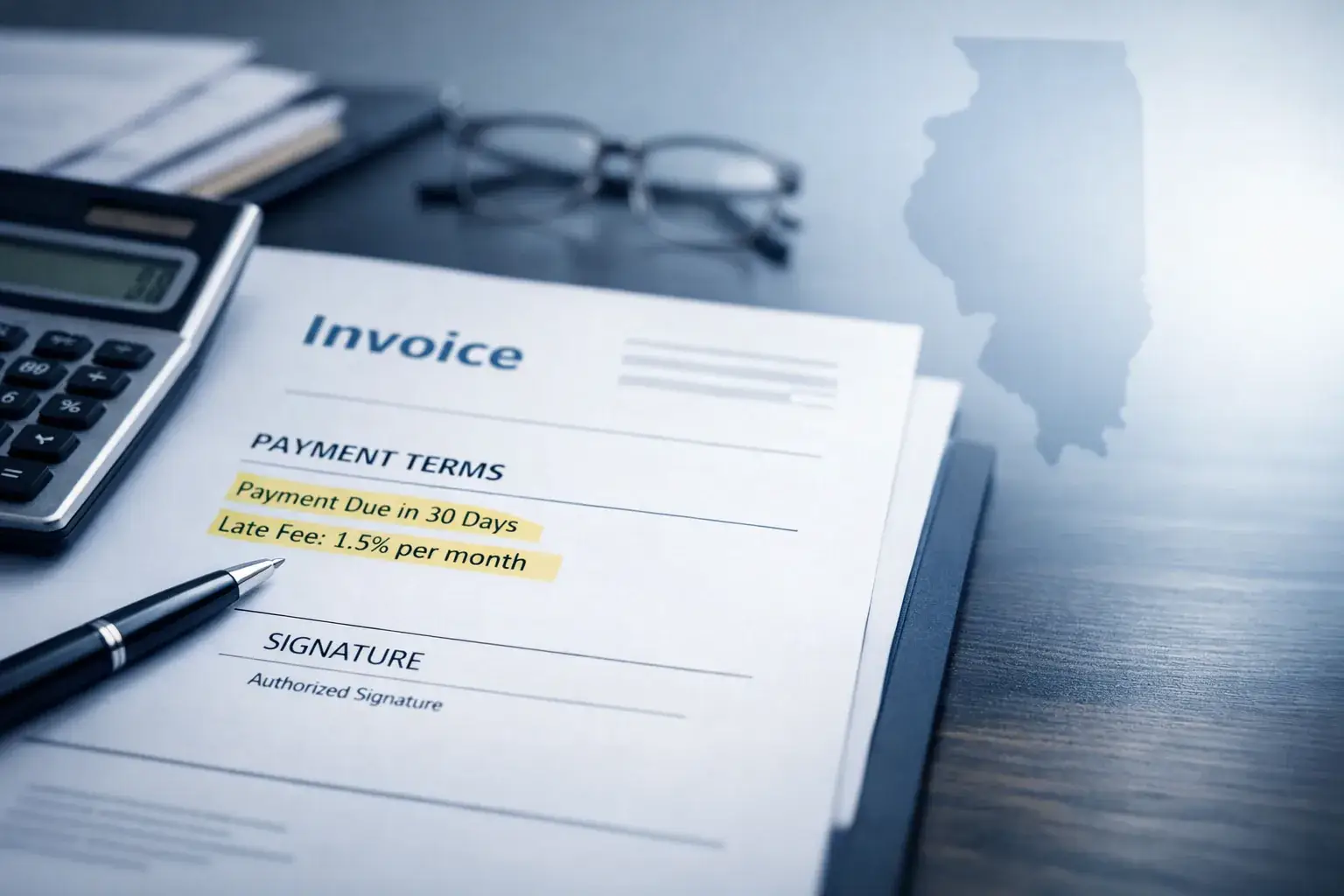
Illinois businesses often copy ‘1.5% per month’ language from old invoices. Sometimes it works. Sometimes it turns into an avoidable fight.
A conservative approach is to draft interest/late-charge language that is defensible under Illinois law and consistent across your contract stack.
For written contracts, Illinois has statutory provisions commonly referenced for interest (e.g., the Illinois Interest Act). Use state-calibrated language rather than a one-size-fits-all clause.
Practical rule: keep payment terms simple, consistent, and paired with a right to suspend work for nonpayment.
- Define when payment is due (Net 15/Net 30) and what counts as ‘received.’
- Add a clear dispute window (e.g., written objections within 7-10 days).
- Include suspension/stop-work rights for nonpayment (and use them).
- Use conservative, Illinois-calibrated interest/late-charge language drafted by counsel.
The 5-part contract-to-cash system (the part templates cannot do for you)
Templates are not the product. Adoption is the product.
If your team can follow these five steps every time, collections improve without a single lawsuit.
- Signed scope (MSA + SOW) before work starts.
- Change order signed before any out-of-scope work.
- Objective acceptance trigger (certificate, email approval, or defined completion milestone).
- Invoice issued with consistent terms and a dispute window.
- Escalation ladder: reminder -> cure notice -> final demand.
What to store (so you are not ‘proving’ your deal later)
Most disputes are evidence disputes. Win by building a proof packet from day one.
A proof packet is a single folder (or single PDF bundle) containing the executed agreement, change orders, acceptance evidence, invoices, and key communications.
- Executed MSA/SOW and any amendments.
- All change orders (signed) with dates and pricing.
- Acceptance evidence (completion certificate, sign-off email, delivery confirmation).
- Invoice + payment reminders + any written objections.
- A short internal note: who approved, who signed, and why.
ROI: why this install pays for itself
A simple ROI model: if you invoice $100,000/month and reduce average AR by even 10 days, you often free up meaningful cash and reduce time spent in dispute.
The point of the install is not theoretical compliance. It’s fewer ‘we’ll pay when we feel like it’ conversations, and fewer invoices stuck in approval limbo.
What ‘done’ looks like in a real Payment Protection Install
Done is not ‘we sent you templates.’ Done means your business has adopted the system.
- Editable contract stack delivered and ready to use.
- Signature authority matrix adopted in writing and distributed internally.
- Invoice template updated with Illinois-calibrated terms.
- Collections trigger ladder templates installed.
- A 45-60 minute rollout/training completed with named owners.
Why Payment Terms Illinois Businesses Use Often Fail at Collection
The payment terms Illinois service businesses most commonly use are copied from old invoices, pulled from generic template sites, or borrowed from a vendor operating in a different state under different rules. The result is language that looks professional but does not function as a collection tool when a dispute actually arrives.
Here is where most Illinois SMBs lose leverage before a dispute even starts.
The “Net 30” trap
Net 30 is not a payment enforcement tool — it is a target. Without a defined method for determining when the clock starts (invoice date? delivery date? acceptance date?), your customer has room to argue every time. Ambiguity is your enemy. Define the trigger in writing, in every contract, without exception.
Late charges that do not hold up
Illinois has specific statutory provisions governing commercial interest and late charges. The Illinois Interest Act (815 ILCS 205) sets a ceiling for certain transactions. Copying “1.5% per month” from an old invoice without counsel review is a common mistake that turns a collection call into an avoidable legal argument. Draft your late charge clause once, get it reviewed against current Illinois law, and use it consistently across your entire customer-facing contract stack. Consistency is the point — inconsistency creates negotiating room you cannot afford to give away.
No acceptance trigger, no leverage
The most overlooked element in most service business contracts is the acceptance trigger. Without a defined event — a delivery acknowledgment, a completion certificate, a written sign-off — your customer can simply say they have not accepted the work yet. That claim delays your invoice and your leverage indefinitely. A functional acceptance clause answers three questions: (1) What event constitutes acceptance? (2) Who is authorized to sign off on behalf of the customer? (3) What happens if the customer is silent after the acceptance deadline?
No right to stop work
If a customer stops paying, most contracts are silent on what happens next. You keep working. The balance keeps growing. The leverage keeps shrinking. A stop-work right — the right to suspend performance for nonpayment after written notice — is one of the highest-leverage clauses a service business can add. It costs nothing to include. It changes the negotiation entirely when it matters.
Dispute windows that favor the customer
If your contract does not include a written dispute window — a specific deadline by which the customer must raise written objections to an invoice — then every payment delay becomes an opportunity to raise new objections. Illinois courts generally uphold dispute window provisions in commercial contracts. Include one, define the window clearly (7–10 business days is standard), and specify that silence constitutes acceptance of the invoice as submitted.
The fix: consistency, not complexity
The payment terms Illinois businesses need to enforce are not complicated. They are consistent. The goal is one customer-facing contract stack — MSA, SOW, change order template, and invoice — that uses the same defined terms in every document. When the terms are consistent, the system is defensible. When they conflict or leave gaps, every dispute starts with your own paperwork working against you. A short legal review of your current stack, followed by a one-time standardization, typically costs far less than a single disputed invoice.
Full Protection Suite (Optional Modules)
If you want more than the spearhead install, these modules stack cleanly without scope creep:
- Revenue & Payment Protection Install (contract-to-cash system).
- Vendor & Change Order Control Install (protect margin and acceptance).
- Signature Authority & Contract Repository Install (find any signed agreement fast).
- Regulated Evidence Retention Add-On (only if your industry requires it; discussed after intake).
For additional reference:
Payment Terms Illinois Businesses Need: Quick Reference
Use this checklist before each customer engagement to confirm your contract system is set up for success. The items above cover the core controls most small businesses need — without overengineering the process.
Frequently Asked Questions
Can you guarantee we will get paid?
No. We can reduce preventable disputes and improve collectability by tightening scope, acceptance, and terms. Enforcement is separate and depends on facts.
Do we need to change our entire contract library?
Not to start. Most companies need one consistent customer-facing stack and a change order rule that is actually enforced.
What if we already have a lawyer?
Great. This install makes your legal spend more efficient by standardizing the documents and workflow.
Will this involve litigation?
Litigation is excluded by default. If it becomes necessary, it is a separate premium engagement.
How fast can this be implemented?
Typically 10-15 business days after you provide inputs, plus a short training session for your team.
Next Steps
If your company invoices customers and you want fewer payment disputes, faster collections, and cleaner documentation, start with a Systems Routing Audit. It is prepaid, fixed scope, and produces a clear bucket recommendation with a pre-filled SOW and a same-day stop-loss checklist.
Litigation is excluded by default; if litigation is ever needed, it is handled only under a separate, premium engagement.
Disclaimer: This content is not legal advice. Past results do not guarantee future outcomes. Contract enforceability depends on facts, industry, and execution.
Related resources on this site: