New
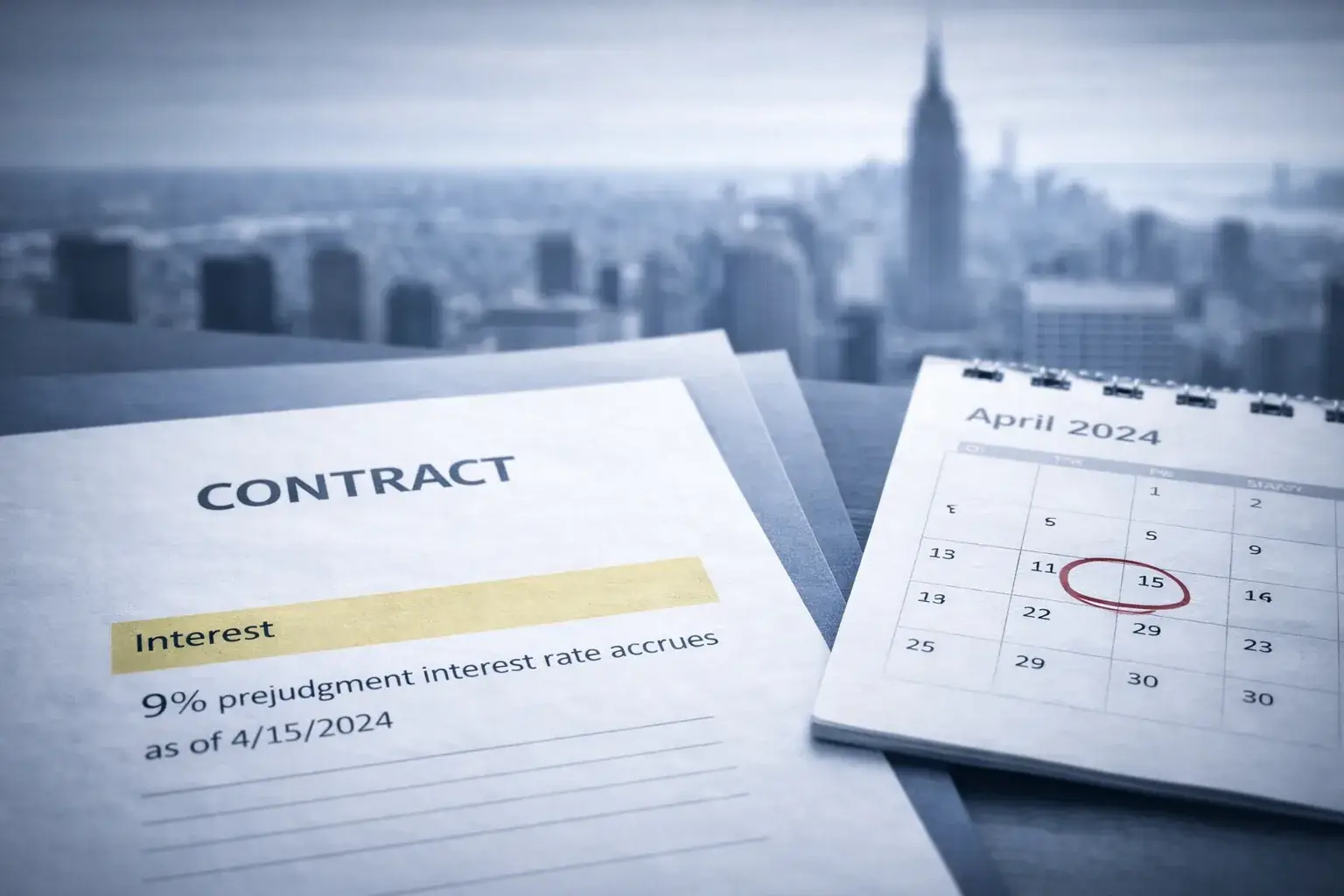
York prejudgment interest rules affect more than litigation strategy — they shape how service businesses should draft invoice terms, define payment triggers, and document acceptance. Most New York SMBs with 10–49 employees discover this only after a customer disputes an invoice. The goal is to design your contract system before that happens.
This article is for informational purposes only and does not create an attorney-client relationship. Every business is different — consult counsel about your specific facts.
Why New York businesses should care about interest even before a dispute exists
Most collection problems are not caused by ‘bad customers.’ They are caused by missing acceptance rules, inconsistent payment terms, and a lack of a documented escalation ladder.
The goal is not to write longer contracts. The goal is to install a simple system your team can actually follow.
In New York contract disputes, statutory interest rules can meaningfully change settlement leverage. But you should not design your system around litigation.
Instead, design around clarity: acceptance, dispute windows, and consistent invoice terms.
Prejudgment interest (plain-English concept for business owners)
Prejudgment interest is a legal concept used in many contract cases to compensate for the time value of money.
Your goal is to avoid getting into a fight about when amounts became ‘due’ or whether the customer disputed the invoice timely.
- Define when payment is due (trigger tied to acceptance).
- Define how disputes must be raised (in writing, within X days).
- Define what happens if payment is late (late charges/interest, suspension).
New York usury sensitivity: keep late-charge language conservative
New York has a well-known civil usury ceiling for loans/forbearance and a higher criminal usury threshold.
For SMB contract systems, the practical rule is simple: use conservative, New York-calibrated language and avoid sloppy drafting that could be re-characterized as a loan or forbearance.
Do not copy-paste invoice interest language from other states.
Invoice terms that reduce disputes in New York
Invoice terms work when they are consistent with the underlying contract and the contract defines acceptance.
A strong invoice is not a threatening invoice. It is a clear invoice.
What ‘done’ looks like
Done means your team has a repeatable contract-to-cash workflow, not a PDF stack in a folder.
- NY-calibrated customer contract stack delivered (MSA/SOW/acceptance/change order).
- Invoice template aligned to the stack.
- Collections trigger ladder templates installed.
- Authority matrix adopted and e-sign workflow configured.
- Repository + proof packet system live.
Why New York Prejudgment Interest Rules Should Shape Your Contract System
The New York prejudgment interest framework is one of the most frequently misunderstood areas of commercial contract design for small and mid-size service businesses. Most owners treat interest as a litigation afterthought — a number a judge applies if things go badly. The reality is that your contract terms, invoice language, and documentation habits determine whether interest rules work in your favor or against you long before anyone considers filing suit.
The New York statutory framework most businesses ignore
New York CPLR § 5001 and related provisions establish when and how interest accrues on contract claims. The statutory rate is set by statute, not by your invoice — and the accrual date depends on when amounts became “due.” If your contract does not define a clear due date tied to acceptance, a customer’s lawyer can argue that the clock started much later than you expected. That ambiguity costs leverage in settlement. New York also has civil and criminal usury provisions that apply differently depending on how late-charge language is characterized. Service businesses that copy invoice interest language from national templates — or from vendors in other states — routinely use language that either creates usury risk or understates what they could lawfully collect. A one-time counsel review of your late-charge clause against current New York law fixes this permanently.
The payment clock that never starts clearly
Net 30 is a payment target. It is not a payment enforcement tool — unless your contract defines exactly what event starts the 30-day clock. Is it the invoice date? Delivery? Written acceptance? For New York prejudgment interest purposes, the accrual date matters: if the due date is ambiguous, the interest calculation is ambiguous. Define the trigger in writing, consistently, in your MSA or SOW. When the clock is unambiguous, disputes about when payment was late disappear, and the conversation about late charges or statutory interest starts immediately.
Dispute windows that close the door on invented objections
One of the most effective clauses a New York service business can add to its contract is a written dispute window: a short, defined period — typically 7 to 10 business days — in which a customer must raise written objections to an invoice. Silence after that window constitutes acceptance. New York courts generally enforce these provisions in commercial contracts when the clause is clearly drafted and both parties had an opportunity to review it. Without a dispute window, a customer who is slow to pay can manufacture objections weeks after the work is complete. The dispute window removes that option — and changes the leverage in any settlement conversation.
The collections ladder that protects the relationship
A structured collections escalation process is not aggressive — it is professional. Define what your team does on Day 1 (invoice sent with dispute window notice), Day 7 (written reminder), Day 14 (cure notice identifying late charges accruing), and Day 30 (final demand with suspension notice). Template the language so the tone is consistent and the paper trail is clear. A ladder that runs without lawyer involvement most of the time saves costs and preserves the customer relationship better than ad-hoc escalation. It also positions you well for the rare case where the relationship cannot be saved — because you have a clean chronology and documented notice.
Stop-work rights as a payment tool
The right to suspend work for nonpayment is leverage — if you draft it correctly and actually use it. New York service businesses add stop-work rights to contracts and then never exercise them because the account team is worried about damaging the relationship. The right to stop work, properly noticed in writing and procedurally clean, converts a slow-pay situation into a payment negotiation. It also limits your exposure to scope creep on unpaid work. Draft the right carefully, define the notice requirement, and train the team on when and how to use it. A clause that no one exercises is not leverage.
Document everything with settlement in mind
The strongest collections position is one where the other side can already see how a judge or mediator would view the facts. Signed SOW. Acceptance email or certificate. Invoices with clear due dates. A timeline of reminders. Written responses to any objections. Even without litigation, a well-organized proof packet settles disputes faster because the customer cannot credibly dispute the timeline. Build the packet as you go — it takes minutes per engagement — and keep it in a central repository so it is accessible when you need it.
Full Protection Suite (Optional Modules)
If you want more than the spearhead install, these modules stack cleanly without scope creep:
- Revenue & Payment Protection Install (contract-to-cash system).
- Vendor & Change Order Control Install (protect margin and acceptance).
- Signature Authority & Contract Repository Install (find any signed agreement fast).
- Regulated Evidence Retention Add-On (only if your industry requires it; discussed after intake).
For additional reference:
- New York CPLR § 5001 — Interest from date of accrual
- Prejudgment Interest — Legal Definition (Cornell LII)
New York Prejudgment Interest: Invoice Checklist
Use this checklist before each customer engagement to confirm your contract system is set up for success. The items above cover the core controls most small businesses need — without overengineering the process.
Frequently Asked Questions
Is this article giving legal advice about interest rates?
No. It is general information. New York interest/usury issues are fact-specific; consult counsel for your situation.
Do invoices need to include interest language?
If you want consistent leverage, your invoice terms should align with your contract terms and be state-calibrated.
Will this help us avoid disputes?
It reduces preventable disputes by defining acceptance and dispute windows.
Is litigation included?
No. Litigation is excluded by default.
How fast can we install this system?
Typically 10-15 business days after inputs.
Next Steps
If your company invoices customers and you want fewer payment disputes, faster collections, and cleaner documentation, start with a Systems Routing Audit. It is prepaid, fixed scope, and produces a clear bucket recommendation with a pre-filled SOW and a same-day stop-loss checklist.
Litigation is excluded by default; if litigation is ever needed, it is handled only under a separate, premium engagement.
Disclaimer: This content is not legal advice. Past results do not guarantee future outcomes. Contract enforceability depends on facts, industry, and execution.
Related resources on this site: