A signature authority policy New York businesses implement prevents a specific and recurring problem: contracts signed by whoever was closest to the deal, with no record of whether that person had authority to bind the company. In growing businesses, this happens constantly — and it creates liability, unenforceable terms, and internal blame games that cost more than the fix.
This article is for informational purposes only and does not create an attorney-client relationship. Every business is different — consult counsel about your specific facts.
Unauthorized signatures are an expensive way to learn governance
In growing companies, contracts get signed by whoever is closest to the deal. A project manager commits to a scope change. A salesperson signs a vendor NDA. An operations lead executes a lease addendum. Each of those signers may have had no legal authority to bind the company — and in New York, the enforceability of an agreement signed by an unauthorized agent depends on facts that are far more expensive to litigate than to prevent.
A signature authority policy is the simplest control most SMBs can install. It takes the question “who can sign?” and turns it from an unwritten assumption into a written rule.
What a signature authority matrix is (and why it beats ‘common sense’)
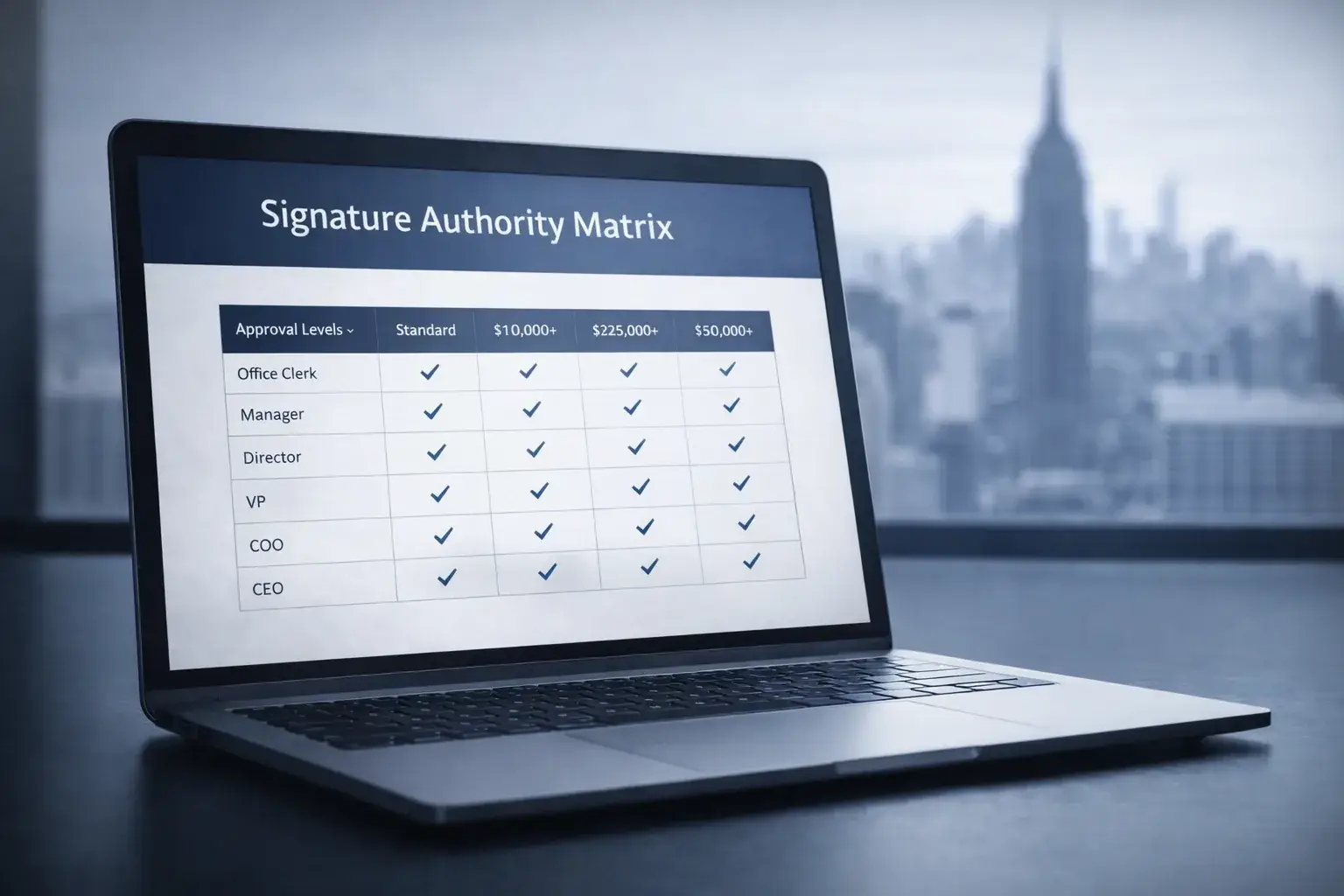
A signature authority matrix is a one-page table that answers: who can bind the company, to what dollar amount, for what categories of agreements, and with what approvals.
The matrix protects your company and your employees by making the rules explicit.
E-signatures and audit trails: make it admissible, not just convenient
Electronic signatures are generally enforceable in New York when handled correctly. The practical risk is not ‘e-sign legality’ as much as bad audit trails.
A defensible e-sign workflow includes: named signer authority, clear version control, completed audit logs, and a clean repository where the executed PDF and proof packet live together.
If you use a platform like DocuSign/Adobe Sign, the workflow should be tied to your signature authority policy (who can bind the company, and at what dollar thresholds). (New York ESRA recognizes electronic signatures, but your process must preserve audit logs and authority.)
Repository: the 5-minute retrieval standard
If you cannot find a signed agreement quickly, you do not have a contract system. You have a hope system.
A contract repository has three parts: (1) naming conventions, (2) a renewal tracker, and (3) a proof packet structure.
- Naming convention: Counterparty – Agreement Type – Effective Date – Version.
- Folder structure: Customers / Vendors / Real Estate / HR / Corporate.
- Proof packet: executed PDF + audit log + key communications + change orders.
The rollout: adoption in writing
A policy that is not adopted is a suggestion. Adoption means management signs off, the team is trained, and the workflow is the default path for every agreement.
- Draft the matrix based on how the company actually operates.
- Adopt it in writing (consent/resolution) and publish it internally.
- Configure e-sign templates to route to authorized signers.
- Create the repository + renewal tracker.
- Train the team and enforce the exception process.
What ‘done’ looks like in a Signature Authority & Repository Install
Done means deals stop slipping through unauthorized paths.
- Authority matrix adopted in writing and distributed.
- E-sign workflow routes to authorized signers only.
- Repository + renewal tracker live under client-controlled logins.
- Team trained (sales, ops, admin).
- Owner assigned for ongoing contract intake and renewals.
Why a Signature Authority Policy New York SMBs Lack Creates Real Risk
Most New York SMBs operate without a written signature authority policy for years — and then discover the gap at exactly the wrong moment: when a contract is disputed, when an employee leaves, or when a vendor demands performance on terms that were never properly authorized.
The unauthorized agent problem
New York law recognizes both actual and apparent authority. An employee who regularly signs contracts for a company may have apparent authority even if they were never formally authorized. That cuts both ways. Your company may be bound by agreements signed by someone who had no actual authority, and your counterparties may escape obligations if the person who signed for them lacked authority to do so. A written matrix eliminates ambiguity by making authorization explicit and documented.
Dollar thresholds that no one has defined
Most companies have an intuitive sense that a junior employee should not sign a $500,000 agreement — but no written rule that says so. A signature authority matrix assigns specific dollar thresholds to specific roles. Below a threshold, a project manager or account manager can execute. Above it, a director or officer is required. Above a higher threshold, board approval may be required. This takes an unstated assumption and converts it into a governance control that is enforceable and auditable.
E-sign tools that are not configured for authority
DocuSign and Adobe Sign route signing to whoever you specify in the template — which means they route to whoever the sender put in the field. Without a signature authority policy integrated into your e-sign configuration, nothing prevents a junior employee from sending a major contract to a counterparty and routing the internal signature to themselves. Configure your templates to route to authorized signers by agreement category and dollar threshold, and lock those routes so they require exception approval to override.
No repository means no proof
Even when contracts are properly signed, New York businesses frequently cannot locate executed copies when a dispute arises. The agreement might be in someone’s email, a shared drive folder with no naming convention, or a physical file cabinet with no index. A contract repository with a consistent naming convention — Counterparty / Agreement Type / Effective Date / Version — and a proof packet structure turns a hope system into a retrieval system. The standard is simple: any executed agreement should be findable in under five minutes by anyone with access to the repository.
Training is the last mile
A signature authority policy that lives in a folder and was never explained to the people who touch contracts is not a control — it is a document. Adoption requires a 45–60 minute rollout session covering who can sign what, what happens when a customer or vendor pushes for a faster path, and who owns the exception process when a situation falls outside the matrix.
Full Protection Suite (Optional Modules)
If you want more than the spearhead install, these modules stack cleanly without scope creep:
- Revenue & Payment Protection Install (contract-to-cash system).
- Vendor & Change Order Control Install (protect margin and acceptance).
- Signature Authority & Contract Repository Install (find any signed agreement fast).
- Regulated Evidence Retention Add-On (only if your industry requires it; discussed after intake).
For additional reference:
- New York Electronic Signatures and Records Act (ESRA)
- Agency and Authority — Legal Definition (Cornell LII)
Signature Authority Policy New York Businesses Need: Summary
Use this checklist before each customer engagement to confirm your contract system is set up for success. The items above cover the core controls most small businesses need — without overengineering the process.
Frequently Asked Questions
Will this slow down sales?
If implemented correctly, it speeds sales by removing last-minute confusion and reducing rework. Exceptions exist, but they are documented.
Do we need a board resolution?
Sometimes. The right adoption mechanism depends on your entity structure and governance documents.
Can we do this with our current tools?
Usually yes. The key is configuration, routing, and repository discipline, not buying new software.
Does an e-signature always hold up in court?
E-signatures are generally enforceable, but enforceability depends on audit trails, authority, and the facts of formation.
Is litigation included if a contract is breached?
No. Litigation is excluded by default and handled only as a separate premium engagement.
Next Steps
If your company invoices customers and you want fewer payment disputes, faster collections, and cleaner documentation, start with a Systems Routing Audit. It is prepaid, fixed scope, and produces a clear bucket recommendation with a pre-filled SOW and a same-day stop-loss checklist.
Litigation is excluded by default; if litigation is ever needed, it is handled only under a separate, premium engagement.
Disclaimer: This content is not legal advice. Past results do not guarantee future outcomes. Contract enforceability depends on facts, industry, and execution.
Related resources on this site: