Your employees are already wearing cameras to work. If your company has no smart glasses workplace policy, the safe assumption is that someone on your payroll has walked into a client meeting, a treatment room, or a production floor with a recording device on their face, and nobody logged it. In August 2026, U.S. Immigration and Customs Enforcement barred its own staff from wearing Meta smart glasses inside federal workspaces, classifying them as personally owned body-worn cameras already prohibited under standing DHS policy. When a federal law enforcement agency decides the risk is not worth it, private employers should take the hint. The exposure is not one statute. It is four, and three of them carry damages.
The Development: Sensing Has Outrun Etiquette
Dr. Alex Wissner-Gross flagged the ICE memo in the August 19, 2026 edition of The Innermost Loop, his daily digest of frontier technology, under a line worth repeating to any executive team: sensing outruns etiquette. He grouped it with two other items from the same week. Comcast began turning millions of home routers into motion sensors. Camera-equipped AirPods surfaced running visual recognition.
The ICE decision itself was widely reported. Acting Director David Venturella issued a memo barring the glasses across ICE workplaces for all employees, not only sworn officers, on the reasoning that the devices “could unintentionally capture, record, or transmit sensitive information.” Coverage from Engadget and The Register tracks the same memo. The New York Times reporting that Wissner-Gross cited also describes leaked DHS budget documents for an agency-built successor device.
Strip out the politics and a plain management fact remains. A mainstream consumer product now records without announcing itself, and it has quietly entered workplaces that never approved it.
What This Means for Your Business
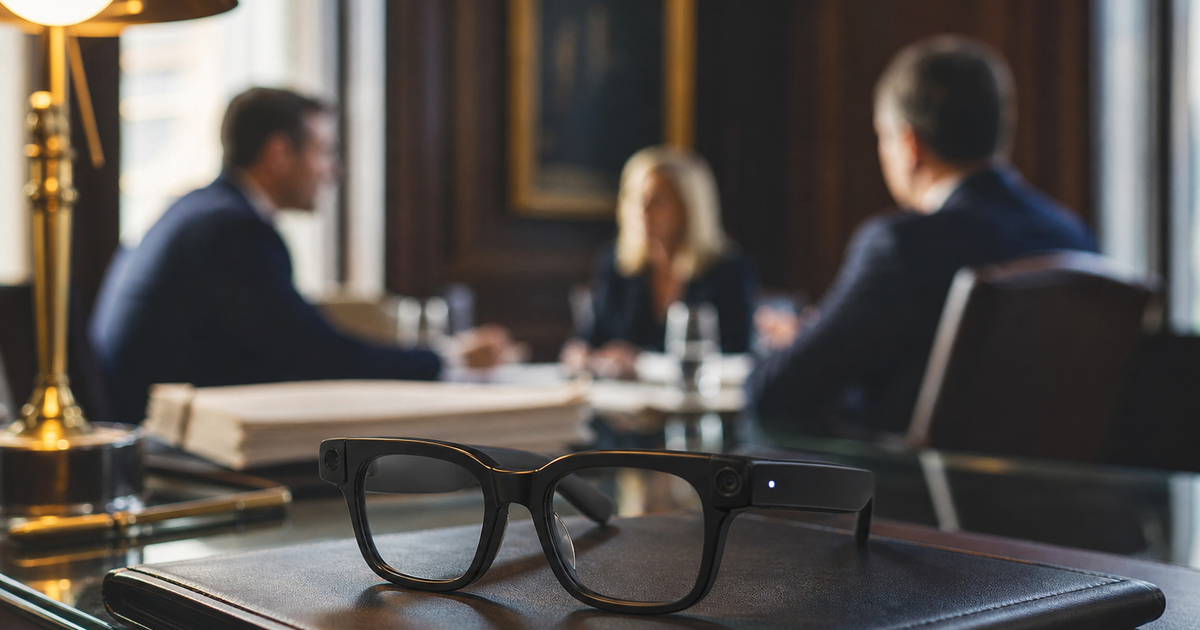
Most employers still think about recording the way they did a decade ago: someone raises a phone, everyone sees it, and social pressure does the rest. Wearables break that assumption. The device looks like eyewear. The indicator light is small and can be covered. Nobody in the room performs the ritual of asking.
That matters because almost every rule governing workplace recording is built on consent, and consent depends on people knowing they are being recorded. Remove the knowing and you have not created a gray area. You have created a violation with your company name on it, because the employee was acting in the scope of employment when it happened.
The practical risk shows up in ordinary places. A sales rep wearing glasses into a client facility. A technician on a hospital service call. A manager recording a termination meeting “for my own protection.” A vendor walking your shop floor while your process is visible on every shelf.
The Legal Impact of a Missing Smart Glasses Workplace Policy
1. Recording consent is not one national rule
Federal law sets a floor, not a ceiling. Under 18 U.S.C. section 2511(2)(d), it is not unlawful for someone who is a party to a communication to record it, or for a recording made where one party consented, unless the purpose is a criminal or tortious act. That is the one-party consent baseline most people have heard about.
States override it. Pennsylvania, for one, permits interception only “where all parties to the communication have given prior consent,” under 18 Pa.C.S. section 5704(4). Several other states take the same all-party approach. So the identical pair of glasses, worn by the identical employee, is lawful in one state and a crime one state line over. A national employer with a single blanket rule will be wrong somewhere.
2. A face scan is not a photograph
Video alone is usually just video. Running recognition on it is a different legal event. The Illinois Biometric Information Privacy Act defines a biometric identifier to include a “scan of hand or face geometry” while expressly excluding photographs. Under 740 ILCS 14/15(b), a private entity may not capture that data unless it first gives written notice that biometric data is being collected, states in writing the specific purpose and length of term, and obtains a written release.
The teeth are in section 20: liquidated damages of 1,000 dollars per negligent violation, 5,000 dollars per intentional or reckless one, plus attorney fees and costs. A 2024 amendment limits a claimant to one recovery per collection method, which trimmed the catastrophic per-scan math, but the per-person exposure and the fee-shifting both survive. We covered the wider pattern in our breakdown of biometric privacy law risks for businesses.
3. A blanket ban can violate federal labor law
Here is the trap that catches well-meaning employers. The instinct is to write “no recording devices, anywhere, ever.” That rule is presumptively unlawful if it has a reasonable tendency to chill protected activity. In Stericycle Inc., decided August 2, 2023, the National Labor Relations Board adopted exactly that standard, overruling Boeing and rejecting its categorical approach to work rules.
An employer can rebut the presumption, but only by proving the rule advances a legitimate and substantial business interest that cannot be served by a more narrowly tailored rule. This applies to non-union workplaces too, because Section 7 protects concerted activity with or without a union. A properly scoped smart glasses workplace policy survives that test. A reflexive prohibition on everything is the version that generates the unfair labor practice charge.
4. Your contracts never say the word “wearable”
Pull your standard NDA, your vendor site-access terms, and your client engagement letter. Almost certainly they restrict “disclosure” of confidential information and say nothing about capture. A vendor whose technician records your facility has not disclosed anything yet, which means your remedy may not have been triggered until the damage is already portable. The same drafting gap we flagged in AI training clauses and in the legal limits on selling company data shows up here: contracts written for documents do not govern sensors.
6 Rules for a Smart Glasses Workplace Policy That Holds Up
- Write it device-neutral. Name the capability, not the brand. “Any device capable of capturing audio, video, or images, including wearables” ages better than a policy that lists Meta and is obsolete when the next product ships.
- Zone it instead of banning it. Identify the actual sensitive areas: client and patient spaces, HR and investigation meetings, R&D and production floors, anywhere covered by a customer confidentiality obligation. Restricting those is the narrow tailoring the Board asks for.
- Map the consent rule per location. Multi-state employers need an all-party-consent list and posted notice at entrances in those states.
- Treat recognition separately from recording. If any device or downstream tool may scan face geometry, you need the written notice, the stated retention term, the written release, and the published retention and destruction schedule before the first capture, not after.
- Push it into your contracts. Add a wearable and sensor clause to NDAs, vendor site-access terms, and visitor agreements. Make capture itself the breach.
- Train supervisors on what not to discipline. An employee recording a wage discussion or a safety complaint may be doing something protected. Discipline there converts a policy problem into a federal charge.
Fold the result into the handbook rather than circulating it as a standalone memo, and re-acknowledge it. Our guide to employee handbook updates covers the mechanics, and our note on workplace robot liability addresses the adjacent question of who answers when the device, not the person, causes the harm.
What to Do Now
Three steps, in order. First, ask. Send a short, non-punitive question to managers about whether any staff or vendors are already using camera wearables on site. You cannot scope a policy around a fact you have not confirmed.
Second, inventory the states where you operate and the categories of information your people are near. Those two lists determine whether your smart glasses workplace policy needs a light touch or a hard perimeter.
Third, call counsel before an incident rather than after. The moment to involve a lawyer is when you are drafting the rule and the contract language, not when opposing counsel has a recording and you are explaining why your handbook did not address it. If a dispute has already reached that stage, the litigation team at Howard Law Group handles matters where the recording itself becomes the evidence, and where the question of what your policy said the day it was made decides the outcome.
Howard East advises businesses on employment policy, technology contracts, and the compliance obligations that arrive with new hardware faster than most handbooks can absorb them. If your workplace policies were written before wearables, they were written for a world where you could see the camera. Book a consultation to review your recording, biometric, and vendor-access language, or reach the firm directly through Howard Law Group.
This article is for informational purposes only and does not constitute legal advice. Recording, biometric, and labor rules vary significantly by state, and the application of any of them depends on your specific facts. Consult a licensed attorney in your jurisdiction before adopting or enforcing a policy.